
With this article, we hope you get a better understanding of what are ISO Certificates, how ISO Certification works, types of ISO Certifications and much more.
Every procurement decision made in healthcare involves more than just commercial value; it has implications for clinical outcomes, patient safety and operational continuity. Whether you are sourcing diagnostic equipment for a tertiary care hospital, laboratory instruments for a pathology facility or medical devices under a government healthcare initiative, supplier credibility is as important as product specifications.
ISO certification is one of the most reliable indicators of that credibility.
ISO-certified suppliers of medical equipment give more assurance to procurement committees, biomedical engineers, purchase officers and government tender authorities that their products and business practices are governed by internationally recognised quality management systems instead of inconsistent operational processes.
But what do these certifications really mean and why are they so important in a vendor evaluation?
Getting to know ISO certifications in Healthcare
International Organization for Standardization (ISO) develops international accepted standards that help organizations in establishing systematic management systems based on quality, compliance, efficiency, and continuous improvement.
Regarding the medical equipment industry, ISO certifications mean that a supplier follows internationally accepted processes that help ensure consistency, regulatory compliance, integrity of documentation and customer satisfaction.
Product quality is still important but purchasing teams are looking more and more at the organisation’s quality systems. That is exactly where the ISO-certified suppliers stand out.
Healthcare facilities run in environments where equipment reliability is non-negotiable. Errors in diagnosis, loss of equipment function or uneven service can directly affect patient care and institution’s efficiency.
Importance of ISO certification while medical equipment procurement
Selecting an ISO-certified medical equipment supplier helps procurement teams mitigate these risks by ensuring the supplier follows documented quality procedures during procurement, distribution, installation support and post-sales service.
Typically, hospital and institutional buyers are offered by certified suppliers:
- Standardised processes for quality assurance.
- More traceability and more reliable documentation.
- Better regulatory compliance.
- Consistent delivery of product and service.
- Systems of corrective and preventive actions structured.
- Increased operating reliability throughout the life of the equipment.
These benefits are even more important during public procurement, where transparency, accountability and quality assurance are the basis of each purchasing decision.
ISO 9001 : Quality Management System
ISO 9001 is the international standard for Quality Management Systems (QMS). It confirms that an organisation has in place effective operational processes to meet customer requirements consistently and to continually improve performance.
Practically, the supplier has documented procedures, quality controls, addresses client input systematically and improves internal process continually.
Hospitals’ procurement teams can be confident that quality is built into daily activities and not just a matter of occasional checks, according to ISO 9001.
ISO 13485: Medical devices quality management system
Among all certifications relevant to the healthcare sector, ISO 13485 is arguably the most significant.
Specifically developed for organisations involved in medical devices and healthcare technologies, this standard focuses on regulatory compliance, risk management, process validation, product traceability, and quality assurance throughout the medical device supply chain.
For hospitals, diagnostic laboratories, blood banks, and healthcare institutions, ISO 13485 provides reassurance that the supplier operates within a management framework specifically aligned with the stringent quality expectations of the medical device industry.
Simply put, it reflects a commitment to delivering medical equipment through processes designed to safeguard reliability, compliance, and patient safety.
ISO 14001: Environmental Management System
Modern healthcare procurement increasingly incorporates sustainability alongside quality and compliance.
ISO 14001 demonstrates that an organisation systematically manages its environmental responsibilities by reducing waste, improving resource efficiency, complying with environmental regulations, and promoting sustainable operational practices.
Partnering with environmentally responsible suppliers supports broader institutional sustainability goals while reinforcing responsible procurement practices.
ISO 45001: Operational Health & Safety management system
An organisation’s commitment to quality is closely linked to the wellbeing of the people responsible for delivering it.
ISO 45001 establishes internationally recognised standards for occupational health and safety management, enabling organisations to identify workplace hazards, reduce operational risks, and maintain safer working environments.
A workforce operating within a safe and structured environment is better positioned to deliver consistent service quality, dependable technical support, and uninterrupted operational performance.
The reason ISO strengthen government tender eligibility
Transparency, accountability and regulatory compliance are key components of government procurement frameworks. This means that many hospital and government tenders require or prefer suppliers with internationally recognised ISO certifications.
These certifications are indicative that a supplier has implemented structured management systems that can maintain quality consistency, documentation integrity, operational discipline and continuous improvement.
For procurement authorities, this means lower procurement risk, higher supplier credibility and increased confidence in long-term service reliability.
ISO-certified suppliers often have a greater ability to support healthcare institutions beyond satisfying eligibility requirements, through equipment installation, maintenance, documentation and after-sales service.
What we offer:
At Cosmic MedTech Solutions Pvt. Ltd., quality is not a separate goal; it is woven into every operational process that supports the delivery of medical equipment to healthcare institutions across India and nearby countries.
We have internationally recognised ISO certifications for our management systems, which serve as proof of our dedication to quality assurance, regulatory compliance, responsibility for the environment, and occupational health and safety.
We are licensed in:
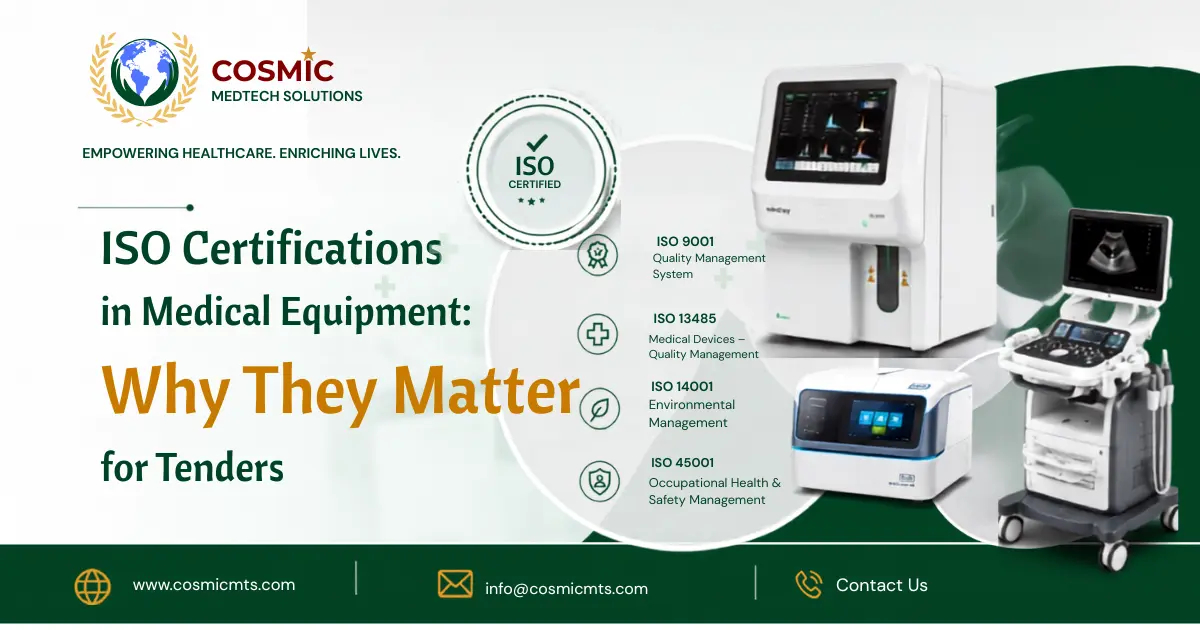
- ISO 9001: Quality Management System
- ISO 13485: Medical Devices – Quality Management System
- ISO 14001: Environmental Management System
- ISO 45001: Occupational Health & Safety Management System
These certifications highlight our commitment towards providing reliable medical equipment solutions to hospitals, diagnostic laboratories, pathology laboratories, blood banks, research institutions and government healthcare organisations, backed by strong quality systems and ethical business practices. To review our certified management systems and supporting credentials, we’d like to redirect you to our Certification Documents Page, where you can get transparent access to our ISO Certificates and form a deeper understanding of our product quality and build trust and assurance around authenticity.