
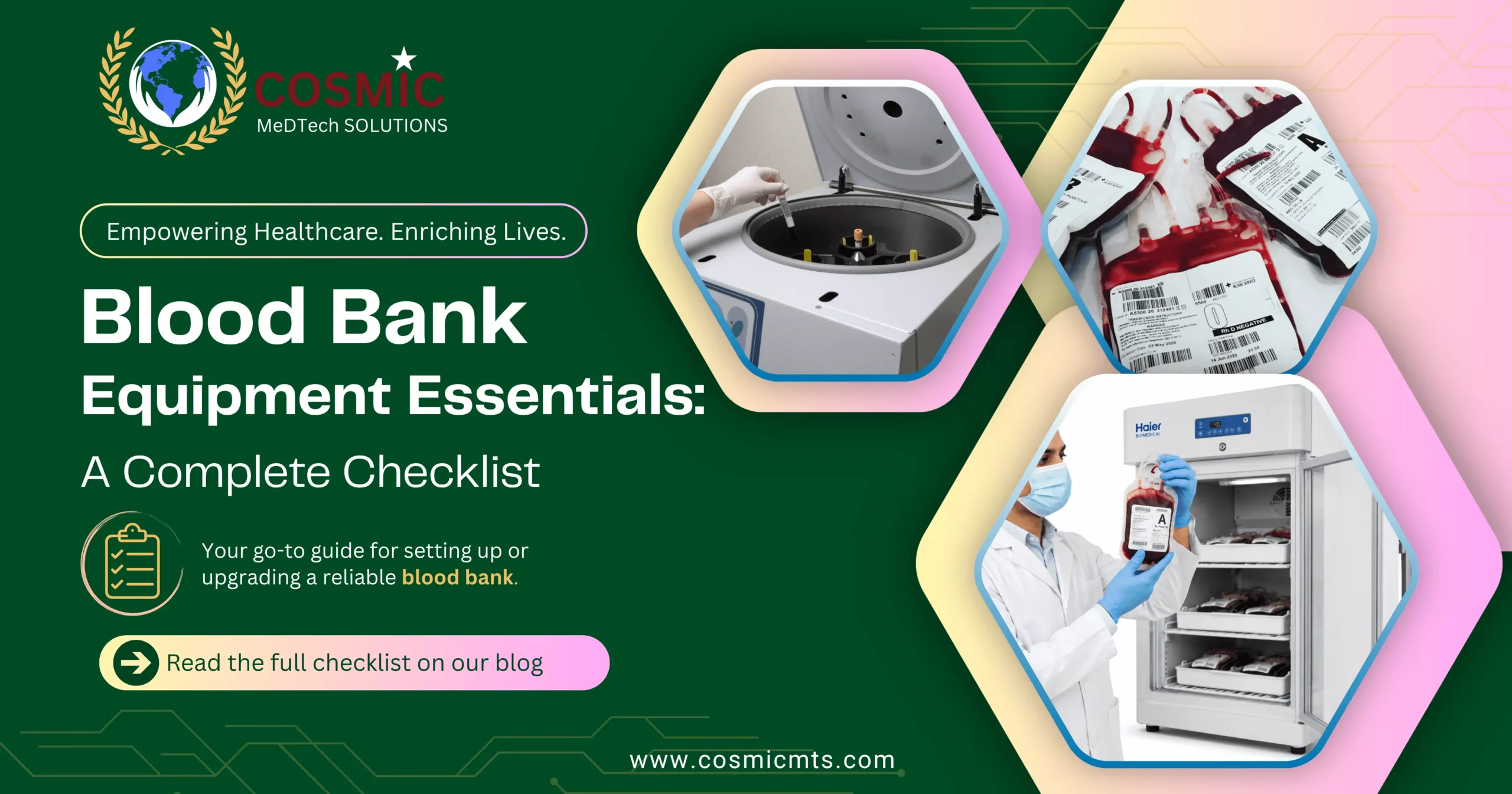
What makes the difference between average and excellent blood banks? What technology should every healthcare institution know about? See a comprehensive list of essential equipment that ensures the highest safety and quality standards in blood transfusion.
A hospital can invest crores in modern infrastructure, but without the right blood bank equipment, even the most advanced facility can struggle to deliver timely and safe transfusion services. Blood products are among the most fragile biological materials in healthcare, and every stage from collection and processing to storage and transfusion demands uncompromising precision. The right equipment protects product integrity, reduces wastage, supports regulatory compliance, and ultimately safeguards patient outcomes.
This is where blood bank equipment comes into play. Blood bank equipment has evolved from being just storage equipment to a complete transfusion chain of command. A blood bank now is a specialised transfusion centre that collects, processes, separates, tests, stores, and distributes blood components to ensure quality and safety are not compromised. Thus, the equipment used in blood banks requires to be of the best quality so that it can perform its tasks accurately and reliably.
Who Should Read This Guide?
- Hospital Procurement Teams
- Blood Centres
- Blood Banks
- Diagnostic Laboratories
- Medical Colleges
- Biomedical Engineers
- NABH/NABL Planning Teams
This guide is designed for:
Whether you are setting up a hospital, upgrading an existing hospital, expanding a blood centre, opening a diagnostic laboratory, or setting up a medical college or a research centre, buying blood bank equipment is one of the most important purchases you will make. The right equipment can help you meet regulatory compliances, reduce wastage of blood, and help you maintain a high level of safety and efficiency in your blood bank. In this blog, we will give you an overview of the different blood bank equipment you need to set up a blood bank, the uses of each of these machines, procurement guidelines, and recommendations.
Why do you need high-quality blood bank equipment?
Blood banking is a highly regulated healthcare sector. Thus, the equipment used for this purpose has to be of the best quality. Blood components such as whole blood, packed red blood cells, fresh frozen plasma, cryoprecipitate, and platelets require special care and storage conditions to maintain their quality and therapeutic value. Thus, investing in the best equipment will help you avoid wastage of blood products due to improper storage, improve your inventory management, and reduce the risk of contamination.
The best blood bank equipment will help you:
- Maintain temperature control of blood products
- Collect, process, store, and transport blood safely
- Reduce wastage of blood products due to improper storage
- Ensure safety and quality of blood products
- Improve emergency response and blood availability
- Enhance the efficiency of your blood bank
- Ensure regulatory compliances are met
- Save on long-term costs by reducing maintenance and downtime
- Ensure uninterrupted supply of blood products
When buying blood bank equipment, organisations must not make the mistake of buying on the basis of cost alone. While it is important to stay within a budget, organisations must invest in reliable equipment as it will help them reduce long-term costs incurred due to maintenance and downtime.
Complete blood bank equipment checklist
A blood bank is a specialised unit that requires a wide range of equipment to process, store, and distribute blood products. Each of these pieces of equipment plays a specific role in maintaining the quality and safety of blood products. Below is a list of blood bank equipment that is essential for the smooth functioning of a blood bank:

1. Blood Bank Refrigerator
A blood bank refrigerator is one of the most important pieces of equipment in a blood bank. This equipment maintains the temperature of whole blood and packed red blood cells at 2°C to 6°C. It is critical to maintain an optimal temperature to avoid damaging the blood products.
Modern blood bank refrigerators have features such as microprocessor control, forced-air circulation, digital display, alarms, battery backup, and temperature recording systems to ensure that the temperature of the blood products is maintained.
Applications:
- Blood banks
- Hospitals
- Medical colleges
- Diagnostic laboratories
- Transfusion centres
- Key features to look for
- Uniform temperature distribution
- Digital microprocessor controller
- Temperature monitoring
- High and low-temperature alarms
- Door-open alarm
- Data logging
- Battery backup
- Adjustable storage shelves
- Energy-efficient
Procurement tip:
It is important to buy blood bank refrigerators instead of standard laboratory refrigerators. Blood bank refrigerators are designed specifically for storage purposes and have superior temperature control and monitoring systems.
2. Blood Plasma Freezer
Fresh frozen plasma has to be stored at much lower temperatures than whole blood. A blood plasma freezer helps in maintaining temperatures of -30°C to -40°C to ensure that the coagulation factors in the plasma are not damaged. These freezers are equipped with features such as rapid cooling, temperature alarms, and backup generators to ensure that the stored blood products are not wasted due to a power outage.
Applications:
- Blood centres
- Hospital transfusion departments
- Regional blood banks
- Plasma storage facilities
- Key features
- Uniform temperature
- Rapid temperature recovery
- Digital temperature display
- Alarm system
- Good insulation
- Backup power supply
- Stainless steel interior
- Organ transplant centres
- Key features to look for
- Temperature maintained between 20°C to 24°C
- Platelet agitation
- Independent temperature monitoring
- Digital display
- Audio and visual alarm
- Energy-efficient
- Transparent doors for easy visual inspection
- Uniform air circulation
Procurement tip:
Look for independent incubator and agitator monitoring. This will help in detecting any faults in the system so that the platelets are not wasted.
4. Blood Collection Monitor
A blood collection monitor helps in collecting the right amount of blood with the correct ratio of whole blood to anticoagulant solution. This equipment helps in maintaining the correct blood collection by continuously measuring the weight of the blood being collected and mixing it with an anticoagulant solution.
A blood collection monitor is important to ensure that the blood collected is not wasted due to improper collection. Moreover, it ensures the safety and quality of the blood products.
Applications:
- Blood donation centres
- Hospital blood banks
- Mobile blood donation camps
- Government blood collection programs
- Key features
- Automatic blood weighing
- Mixing with anticoagulant solution
- Flow rate monitoring
- Automatic clamp
- LCD or touch screen
- Battery backup
- High collection accuracy
- Portable
Procurement tip:
Look for programmable collection features and calibration support. This will help you collect the right amount of blood with the correct ratio of anticoagulant solution.
5. Blood Bank Centrifuge
A blood bank centrifuge is a vital piece of equipment that helps in separating whole blood into its components. Instead of storing whole blood, hospitals store the different blood components such as packed red blood cells, platelet concentrates, fresh frozen plasma, and cryoprecipitate. This helps in reducing wastage of blood products and ensures that the right blood components are transfused to the patients.
Modern centrifuges have features such as programmable protocols, refrigeration, and variable speed to ensure that the blood components are separated efficiently.
Applications:
- Component separation laboratories
- Blood banks
- Transfusion medicine departments
- Medical colleges
- Key features
- Refrigerated rotor
- Programmable protocols
- Variable speed
- Automatic imbalance detection
- Low vibration technology
- Digital control panel
- Automatic lid locking
- High-capacity rotor options
Procurement tip:
While looking at the RPM of a centrifuge, it is important to look at the number of units you have to process on a daily basis and the rotor options available. It is more important to look at the refrigeration options and maintenance requirements.
6. Plasma Thawing System
Fresh frozen plasma cannot be directly used for transfusion. The fresh frozen plasma has to be thawed at specific temperatures before it can be used for transfusion. A plasma thawing system helps in thawing the fresh frozen plasma without damaging its coagulation factors.
Applications:
- Blood banks
- Hospital transfusion services
- Emergency departments
- Trauma centres
- Key features
- Uniform water circulation
- Accurate temperature control
- Digital timer
- Multiple bag capacity
- Stainless steel chamber
- Easy cleaning
- Alarm system
- Procurement tip
Procurement Tip:
Look for rapid thawing systems with temperature control to ensure that the fresh frozen plasma is thawed without damaging its coagulation factors.
7. Blood Bag Tube Sealer
A blood bag tube sealer is an essential piece of equipment that helps in sealing blood bag tubes using radio-frequency technology. These sealers are used in blood banks to ensure that the blood bag tubes are properly sealed so that there is no risk of contamination.
Portable blood bag tube sealers are especially useful in mobile blood donation camps.
Applications:
- Blood banks
- Component preparation laboratories
- Mobile donation camps
- Key features
- Radio-frequency technology
- Fast sealing
- Portable
- Battery operated
- Durable
- Consistent quality of seal
8. Blood Donor Chair
A blood donor chair is an important furniture in a blood donation camp. Blood donation is a tedious process and the donor has to wait for 8 to 15 minutes for the blood to be collected. Thus, it is important to have comfortable donor chairs so that the donors do not feel uncomfortable during the donation process.
Key features:
- Electrically adjustable positions
- Comfortable armrests
- Easy-to-clean upholstery
- Sturdy frame
- Ergonomic design
- Smooth reclining mechanism
9. Blood Bank Temperature Monitoring System
A temperature monitoring system is essential for a blood bank. The monitoring system helps in tracking the temperature of the blood bank refrigerator and plasma freezer. In case of any irregularity, the monitoring system notifies the staff.
The modern temperature monitoring system comes with features like cloud connectivity, SMS alert, email alert, and data logging facility.
Key features:
- 24×7 monitoring
- Remote access
- SMS alert
- Email alert
- Data logging
- Audit trail
- Cloud connectivity
10. Backup Power System
The backup power system is necessary to avoid any power cut interruptions. A backup power system safeguards the blood products from being wasted. Most hospital setups have an uninterrupted power supply (UPS) and a generator in case of a power outage to avoid any damage to the blood bank equipment.
Key features:
- Automatic power switching
- UPS backup
- Generator compatibility
- Voltage protection
- Uninterrupted power supply
- Emergency backup monitoring
Blood Component Storage Temperature Guide
Each blood component needs to be stored at a specified temperature to maintain its quality and therapeutic application. See the table below to know which blood components are stored in which equipment at a specified temperature.
Blood Component Storage Temperature Equipment
- Whole Blood 2°C to 6°C Blood Bank Refrigerator
- Packed RBCs 2°C to 6°C Blood Bank Refrigerator
- Fresh Frozen Plasma -30°C or below Plasma Freezer
- Cryoprecipitate -30°C or below Plasma Freezer
- Platelet Concentrate 20°C to 24°C with continuous agitation Platelet Incubator with Agitator
Common Procurement Challenges
Healthcare organisations face various avoidable procurement challenges while acquiring new equipment. Understanding these procurement challenges will help an organisation make the right purchasing decisions.
Some of the procurement challenges are as stated below:
- Wrong capacity selection: Going for a smaller capacity may hinder smooth operations while going for a larger capacity may lead to a higher capital outlay.
- Buying lab refrigerator instead of a blood bank refrigerator: Laboratory refrigerators do not meet the necessary specifications for storing blood components.
- Lack of future expansion consideration: Some organisations overlook the need for future expansion when acquiring new equipment
- Poor after-sales service: Delayed service support may lead to longer equipment downtime
- Lack of monitoring devices and alarms: Without proper alarms and monitoring systems, there is no assurance of the equipment’s performance.
- Limited spares availability: This may lead to longer equipment downtime and increased repair costs
- Calibration and validation challenges: Equipment calibration and validation are critical in ensuring accuracy in any clinical laboratory functions
Blood bank equipment buying guide
Buying blood bank equipment is a challenging task, and organisations have to consider various factors before making the purchases. The significant factors to consider while purchasing blood bank equipment include:
- Regulatory compliance
- Temperature accuracy
- Capacity
- Monitoring and alarm
- Installation and validation
- Preventive maintenance
- Energy efficiency
- Service network
In addition to the factors stated above, it is essential to understand the most common mistakes organisations make when purchasing blood bank equipment.
The most common mistakes made when purchasing blood bank equipment include:
- Purchasing standard lab equipment instead of purpose-made blood bank equipment
- Making the purchasing decisions based solely on prices
- Failing to consider future expansion
- Failing to consider after-sales service
- Failing to consider monitoring and alarms
- Failing to consider staff training
How to choose the right blood bank equipment supplier?
Choosing the right supplier is as important as purchasing the right blood bank equipment.
A good supplier will have enough experience and knowledge about blood bank equipment and provide quality services to the client.
While choosing a supplier for your blood bank equipment, consider the below aspects:
- Experience: The right supplier will have the knowledge of handling different blood bank equipment models based on the client’s application needs
- Product portfolio: Choose a supplier with a wide range of products that can support your entire blood banking process
- Installation and commissioning support: The right supplier offers installation and commissioning service to ensure smooth operations
- Preventive maintenance and repairs: Opt for suppliers that offer maintenance and repair services as the service is crucial to the equipment’s longevity
- Calibration and validation: Choosing a supplier that offers calibration and validation services support the desired performance of the equipment
- Spares availability: A reliable supplier offers spare parts to ensure minimal downtime whenever there is a malfunction
- PAN India service network: Choose a supplier with an extensive service network to ensure faster response and resolution of any service-related issues
- Technical support: Ensure the supplier offers technical support in case of any technical problems with the equipment
- Training: The best suppliers offer training to the client on the proper use of the equipment to avoid mishaps
- Warranty and service terms: Understanding the supplier’s service and warranty terms will help the client estimate the maintenance costs
Conclusion
When purchasing blood bank equipment, organisations must consider the above factors and avoid the common mistakes associated with the procurement process.
Purchasing decisions based on these considerations will promote smooth operations, compliance with the applicable standards, reduce the cost of operations, and enhance good quality assurance. Choosing the right equipment supplier is vital and should not be overlooked in the procurement process. Finally, it is important to buy the equipment from a reputable supplier.
Speak with a blood bank equipment specialist
Are you planning to start a new blood bank or upgrade your current blood bank? Do you want to set up a diagnostic lab?
Cosmic MedTech Solutions can help you with blood bank equipment and cold chain equipment. We offer a wide range of blood bank equipment for your hospital blood banking needs. Our team of professionals can assist you in the installation and commissioning of the equipment. Contact us to get further information on the equipment we offer and the solutions we provide.